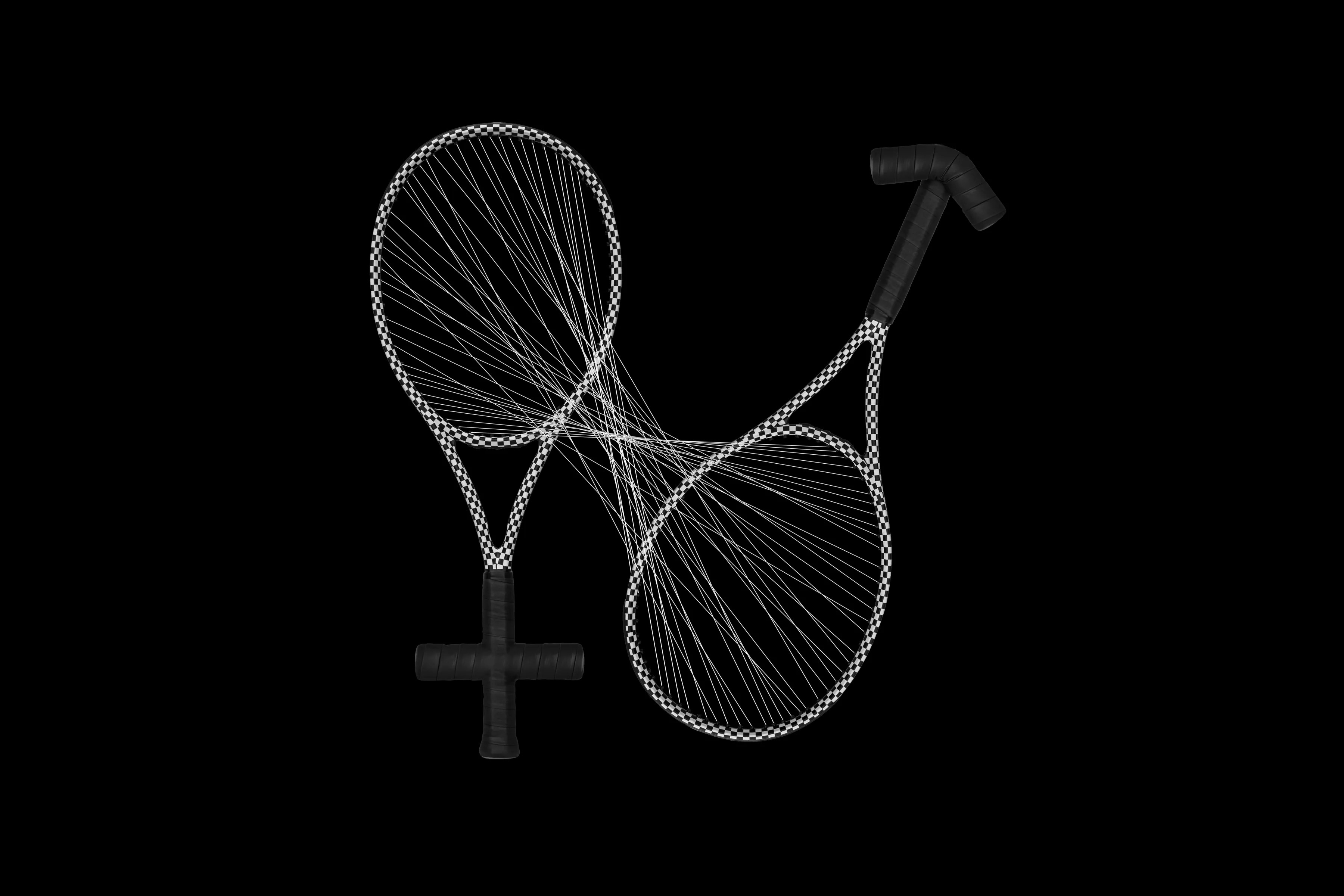

The memory doesn’t start with the violence. It starts with the silence—a mundane, routine pause during a changeover at 1993’s Citizen Cup in Hamburg, Germany. Despite being the fifth oldest tournament in the world, it probably felt like a throwaway to anyone but the players and the most dyed-in-the-wool tennis fans. Monica Seles was using the week as a tune-up for the French Open, finding her rhythm on the clay before the stakes turned global in a major way.
She sat on the changeover bench, hunched slightly, sipping from a plastic cup of water. In that moment of vulnerability, the sanctuary of the court dissolved.
The surface at Am Rothenbaum is tight, so Seles was seated mere inches from the railing. Günter Parche didn’t have to leap; he only had to reach. He moved with terrifying, bureaucratic purpose. He stepped toward the railing and drove a nine-inch boning knife between Seles’ shoulder blades. Then came the sound—the sudden, collective hitch in the breath of ten thousand people in Hamburg.
In April 1993, Monica Seles was nineteen. She had quickly become the undisputed queen of the baseline, a teenager whose aesthetic brilliance—that grunting, two-handed ferocity—had systematically dismantled the established hierarchy of tennis in the matter of a few seasons.

The wound Parche inflicted was less than an inch deep, but the chasm it opened was infinite. We usually talk about the Seles stabbing as a freak occurrence, a tragic security lapse from a more innocent time. But looking at it now, through the fog of 2026, it feels like a Patient Zero event. It was a physical manifestation of a logic that has since become our default: the idea that an athlete is not a human to be witnessed, but a data point to be managed, edited, or deleted.
To [Parche], Graf was the rightful world number one, and Seles was a glitch—a distortion to be fixed.
Günter Parche was not a tennis fan in any healthy sense. His fixation on Seles’ chief rival Steffi Graf was a clinical madness. He didn’t love the game; he loved the order of it. To him, Graf was the rightful world number one, and Seles was a glitch—a distortion to be fixed. He used a blade to manipulate the rankings when the world had, in his view, gone out of alignment.
This impulse—the belief that an athlete’s existence is just a variable to be optimized—has since been somehow both decentralized and institutionalized. We’ve moved from the lone stalker with a knife to a global apparatus of surveillance and analytics that performs a different but connected kind of daily violence. When we look at an athlete now, we’re encouraged to see a collection of metrics, flattening the soul of the game.
There is a tragedy in this flattening of course, and its roots are visible in the immediate aftermath of the Seles attack. Less than a week after the stabbing, while Seles was still reeling from the injury and the shock, the Women’s Tennis Association gathered in Rome to vote on the state of her ranking. The result was a chilling exercise in institutional logic.
While most top players voted to unfreeze Seles’ ranking—effectively stripping her of the No. 1 spot—Gabriela Sabatini was the only one who abstained. The rest chose the ledger. Seles later wrote that no consideration was given to her position, and that Sabatini was the only one who thought about a human being before a dollar amount or ranking points.
To judge an athlete primarily through data is to negate their physical and emotional existence. Seles did not just win tennis matches; she did so with a merciless elegance that was unquantifiable. At one point, the popular opinion wasn’t if she’d break the all-time women’s grand slam record, but when she would do so.
The electronic line judge has finally swallowed the chalk dust.
Thus, that choice in Rome wasn’t just a moment of professional callousness; it was a blueprint. In the decades since, we’ve perfected the art of looking past the person to stare at the projection. We’ve built an ecosystem where the version of the athlete we consume—the aggregate of their Tennis IQ scores, their live betting odds, their curated social media personas—is more substantial than the breathing human on the court. We track the movement of their metrics with more intensity than the movement of their feet.
This is the threshold of the hyperreal. Jean Baudrillard’s concept of a world where the simulation replaces reality has moved from the black box of the academy to center court. The electronic line judge has finally swallowed the chalk dust.
We see this most clearly in the way the public now shorts athletes in real time. On prediction markets like Kalshi and Polymarket, a star player is no longer a person in a jersey. They’re a volatile stock whose injury or psychological break is just another market fluctuation to be exploited.
When a great but fallible player like Juan Martin del Potro just can’t stop injuring his wrists and knees, or when an up-and-coming star like Emma Raducanu struggles with the physical reality of her own body because she’s being stalked by multiple sickos, the digital response is rarely empathy, but a demand for some sort of correction.
The fan who has bet against a player’s greatness or longevity becomes a stakeholder in their downfall. In this ecosystem, the athlete is transformed into a data-double, a digital proxy whose value is determined by its predictability. That abstraction now expresses itself most nakedly through betting, not because any one sport is uniquely warped by it, but because the logic is portable and ruthless wherever it’s applied. And tennis is simply one of countless venues making the transaction visible.

During the 2025 French Open, for example, Britain’s Katie Boulter disclosed that she received explicit threats aimed at her and her family during a match—messages triggered not by defeat, but by the loss of a first‑set tiebreak that flipped live betting markets. One read, “Hope you get cancer.” Another promised damage to her “grandmother’s grave if she’s not dead by tomorrow,” followed by “candles and a coffin for your entire family.” A third message stripped away any remaining pretense of fandom: “Go to hell, I lost money my mother sent me.”
the athlete is no longer encountered as a person subject to chance, fatigue, or fear, but as a fluctuating instrument…
Elina Svitolina described the same pattern after a loss in Canada, sharing messages that wished her death and explicitly referenced betting losses. “To all the bettors,” she wrote, pointedly, “I’m a mum before I’m an athlete.” In a landscape where outcomes are continuously priced and repriced, the athlete is no longer encountered as a person subject to chance, fatigue, or fear, but as a fluctuating instrument—expected to behave predictably, punished when volatility reasserts itself.
This logic does not stop at the net or the baseline. In the NBA, Jaylen Brown has articulated the same pressure from inside a far larger machine. As betting has been folded into the league’s infrastructure, Brown has argued, so too has hostility toward players who see none of the profits but absorb the fallout. Money, he warned, “creates a negative discourse around the game and players,” one that licenses confrontation when parlays miss and projections fail. (Brown is on record stating that any bettor inclined to “run up on him” about a parlay should expect a non‑statistical outcome.)
Across sports, the pattern holds. The athlete is no longer met as a human body moving through uncertainty, but as a model. And when that model breaks, the response is not disappointment or even anger, but correction—a demand that the physical world realign itself with the numbers that arrived first.
When the betting pool or the AI prompt or the analytics forecast predicts a downfall, it creates a gravitational pull on reality. The match itself is no longer the event; the movement of the metrics is. If the simulation predicts one thing or another—a win, a loss, an injury, a tragedy—it prompts the physical world to provide the necessary conditions. The outcome, whatever it may be, becomes a statistical inevitability—a way for the physical world to catch up to the digital map that’s already been drawn.
But perhaps the most profound shift is the collapse of our ability to trust what we see. In 1993, we had the tape. We saw Parche reach over the rail and thrust his blade into Seles’ back. We agreed on the wound. Today, that on-the-ground truth is being eroded. We’re being told by powerful forces to disregard the evidence of our own senses—to see every physical trauma as a narrative threat or a potential deepfake.
reality now arrives second, trailing the simulation.
This is a war on the witness. It’s the demand that we surrender our memory to an archive that is increasingly managed to ensure the rightful order is never seen to be broken. We’re already rehearsing this logic. When cricket legend Sachin Tendulkar (known as the God of Cricket in India) was recently forced to publicly deny an AI‑generated video falsely depicting him endorsing a betting app—a double whammy of digital shit—the damage had already been done. Not because anyone truly believed the clip was real, but because reality now arrives second, trailing the simulation. The refutation becomes part of the noise.

If Seles were stabbed today, the institutional response would not be to clarify the violence, but to manage it—to slow the spread of the footage, to contextualize it into abstraction, to litigate its framing until the physical reality of the knife felt like a subjective opinion. The simulation would absorb the strike, process it into a data point, and tell us that what we saw was merely a hiccup in the feed.
To consider Monica Seles today is to ask what it means to actually witness another human being. It is a defense of aesthetic brilliance against cold data. The game Seles played was an affront to the clinical because it was so undeniably, physically there. You could not manage her dominance; you had to experience it.